Introduction
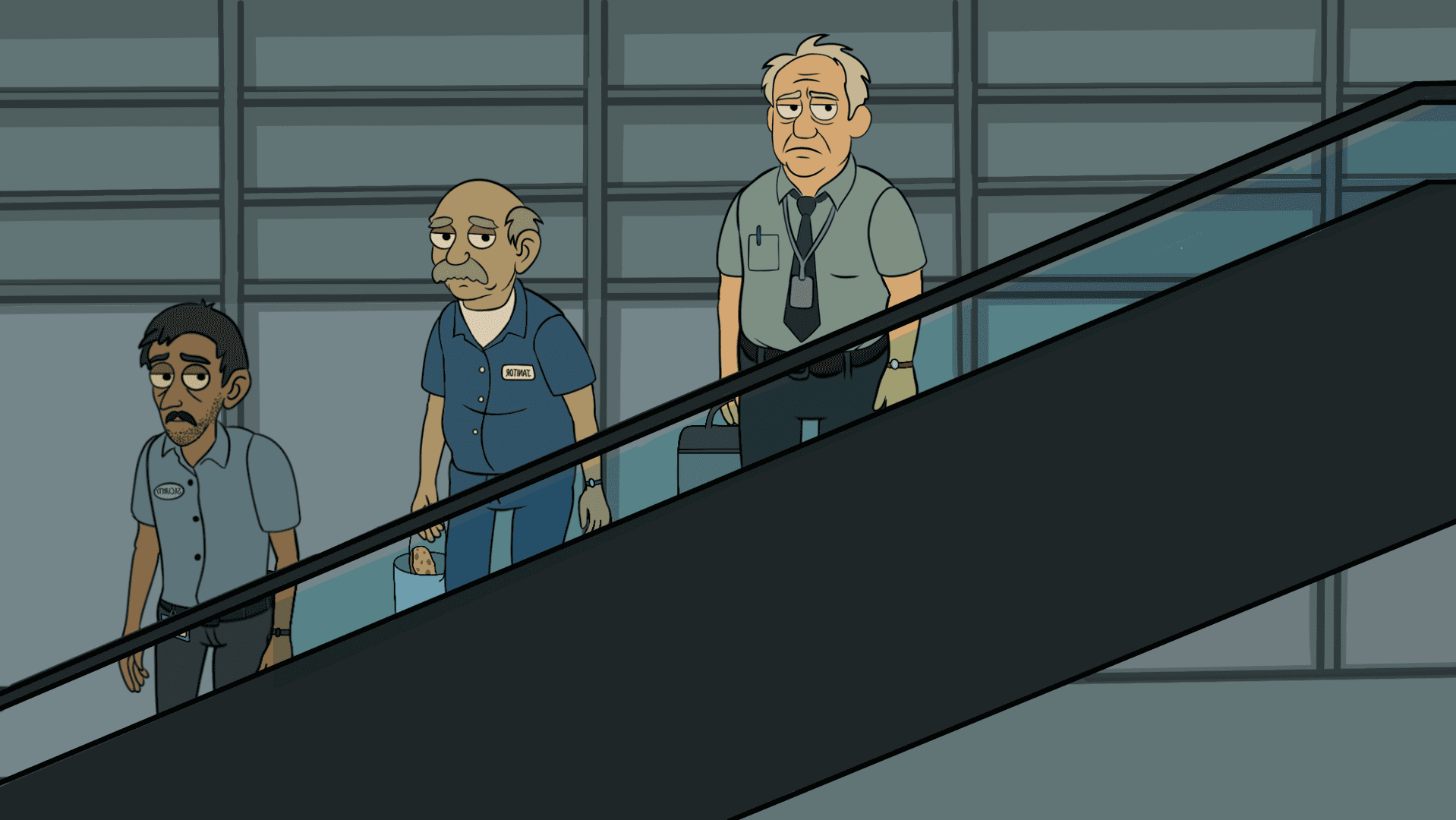
By Default follows a janitor, a security guard, and an office employee through identical, mechanical routines. Whenever one of them does something unproductive like snoozing an alarm, taking a sigh, saying hello to a stranger, they glitch back into the loop.
The film is a study of Marx's theory of alienation, staged not as boredom, but as a system that treats any flicker of selfhood as a mistake to be reset.

"The alienation of the worker in his product means not only that his labour becomes an object, an external existence, but that it exists outside him, independently, as something alien to him."
— Karl Marx, Economic and Philosophic Manuscripts of 1844

A Tool for Resistance
Alienation here isn't a mood caused by a boring job. It's structural- built into the relationship between worker and system, whatever the work feels like day to day.
According to the October Group's Manifesto, the task of art “is to raise the ideological, cultural and domestic level of strata of the working class and of those workers who are undergoing an alien class influence (the bourgeois)”.
Karl Marx’s theory of alienation, which highlights how capitalism detaches individuals from their labour, the products they create, and ultimately from themselves. This became particularly relevant when analysing monotonous jobs that suppress autonomy and creativity.

The Making Of
The film draws heavily from Adult Swim’s character design, the glitch motif from Come and Learn with Pibby, and the rough, expressive animation style of works like Le Café.
All visual elements including character face and body profiles, props (such as alarm clocks, mops, buckets, and security wands), and illustrated backgrounds were created in Procreate. Frame-by-frame animations were also hand-drawn in Procreate to retain a raw, expressive quality.
The full animation was then composited and timed in Adobe After Effects, where all motion, glitch effects, and sound design were added. The soundscape, including ambient loops and distortion effects, was layered in After Effects to heighten the film’s surreal, repetitive atmosphere.

